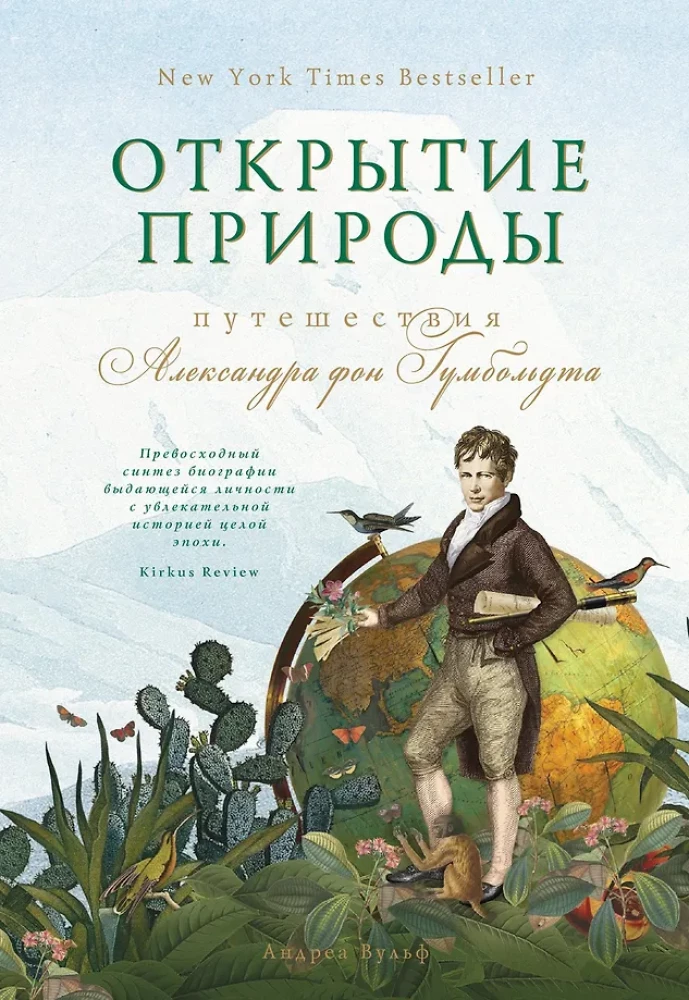
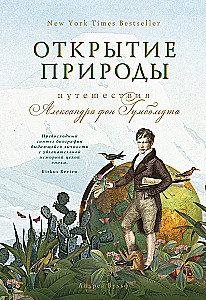
The Opening of Nature: The Travels of Alexander von Humboldt
The name of this man is heard everywhere: from the Humboldt current off the coasts of Chile and Peru to dozens of monuments, parks, and mountain ranges in South America, including Sierra Humboldt in Mexico and Humboldt peak in Venezuela....
In his honor, a city in Argentina, a river in Brazil, a geyser in Ecuador, and a bay in Colombia are named. In Greenland, there is a cape and glacier named after Humboldt, and the Humboldt mountains can be found on maps of northern China, southern Africa, New Zealand, Antarctica, while the Humboldt river and waterfalls are located in Tasmania and New Zealand. Parks named after him exist in Germany, and in Paris, there is a street named after Alexander von Humboldt. In North America alone, the name Humboldt is given to four counties, thirteen cities, mountains, bays, lakes, and one river, a natural park in California, parks in Chicago and Buffalo, and the state of Nevada almost became the state of Humboldt in the 1860s. His name is borne by around 300 plants and more than 100 animals, including Humboldt's California lily, the South American Humboldt penguin, and the fierce predator - the two-meter Humboldt squid found in the waters of the Humboldt current. He is commemorated in the names of six minerals - from humboldtite to humboldtine, and one of the areas on the moon is called Mare Humboldtianum. More places are named in honor of Humboldt than anyone else. Marked by a brilliant constellation of awards and prestigious prizes from the most respected Western scientific communities and media, the book tells the story of the life and work of this outstanding figure - the German encyclopedic scientist Alexander von Humboldt (1769–1859), a naturalist, zoologist, and botanist, traveler and geographer, one of the founders of physical geography as an independent science, as well as landscape science, ecological geography of plants, geomagnetism, and climatology. His ideas were of great significance for the development of science, the field of nature conservation, the understanding of the relationship between humanity and nature, art and nature, poetry and nature, politics and nature. Based on numerous documentary sources, diaries, extensive correspondence, reports of the scientist's travels, as well as the author's own travels and studies, not only the main milestones of Humboldt's scientific biography are revealed, but also his character, emotions, aspirations, and weaknesses. An engaging intellectual biography, the most complete portrait of one of the most versatile naturalists in the world.
Author: Андреа Вульф
Printhouse: KoLibri
Series: Persona
Age restrictions: 16+
Year of publication: 2019
ISBN: 9785389135338
Number of pages: 464
Size: 240х160х32 mm
Cover type: hard
Weight: 880 g
ID: 518829
Sold out
€ 17.29
Sold out
€ 17.29
Bestsellers







€ 13.29
In stock
12 Weeks in a Year. How to Achieve More in 12 Weeks Than Others Do in 12 Months
Майкл Леннингтон, Брайан Моран


€ 7.89
In stock
Choice. On the Freedom and Inner Strength of a Person
Эдит Ева Эгер, Эсме Швалль-Вейганд




€ 6.99
In stock