





National Interests. Some Propositions for German and European Policy in an Era of Global Upheaval
Author: ДОНАНЬИ К. ФОН
Printhouse: AST
Series: New World Order
Age restrictions: 18+
Year of publication: 2024
ISBN: 9785171570354
Number of pages: 240
Size: 207x144x24 mm
Cover type: hard
Weight: 320 g
ID: 1665311
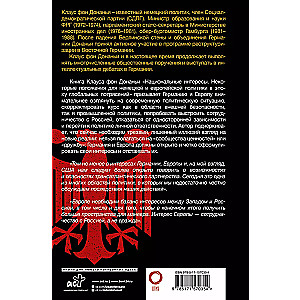
Klaus von Donanyi is a renowned German politician, a member of the Social Democratic Party (SPD). He served as the Minister of Education and Science of the Federal Republic of Germany (1972–1974), parliamentary state secretary in the Ministry of Foreign Affairs (1976–1981), and Mayor of Hamburg (1981–1988). After the fall of the Berlin Wall and the reunification of Germany, Donanyi took an active part in the restructuring program in East Germany. Klaus von Donanyi continues to carry out numerous public assignments and participate in intellectual debates in Germany. His book "National Interests. Some Propositions for German and European Policy in an Era of Global Upheaval" urges Germany and Europe to take a closer look at the current political situation, adjust their course in both foreign security and industrial policy, seek to build cooperation with Russia, abandon unilateral dependence, and move towards a policy of personal responsibility. The author emphasizes that a sober, reality-based view of the new situation is now necessary: one cannot rely on "communities of values" or "friendship"; Germany and Europe must openly and clearly articulate their interests and stand up for them.
Bestsellers