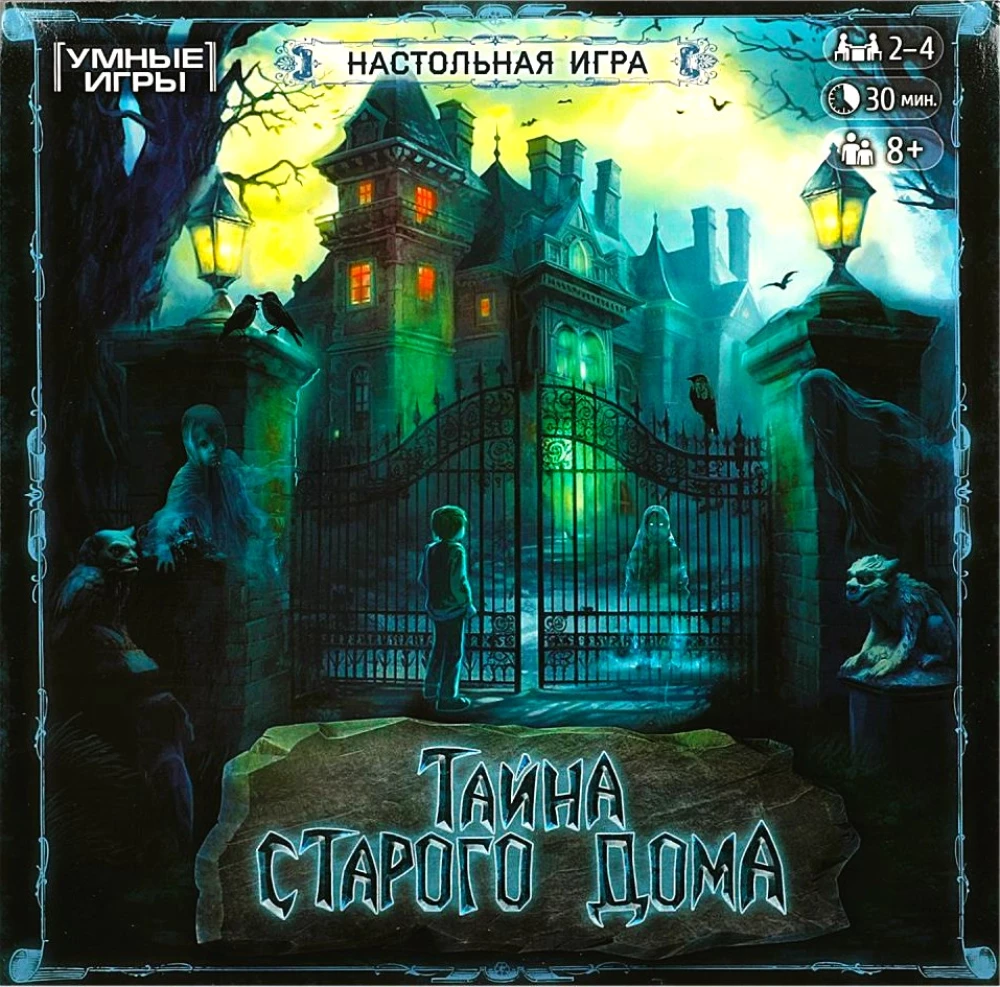
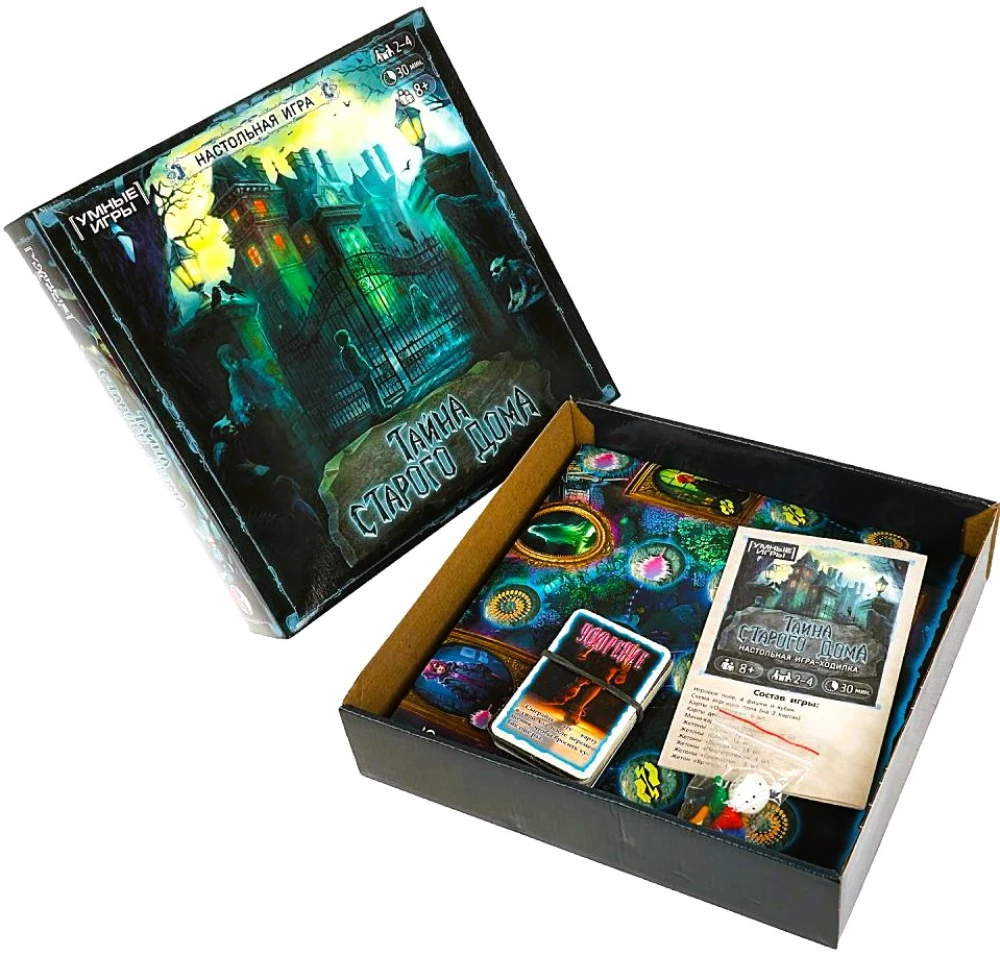
Board Game - The Mystery of the Old House
When mysterious shadows appear in the old house, the lights flicker, and eerie laughter is heard – it's time to call for ghost hunters! Join the team of young paranormal investigators, uncover the secret of the old house, and banish...
the vengeful phantom while there's still time… One of the players will take on the role of the mysterious phantom, while the others will be ghost hunters.
Game Objective:
The goal of the hunters is to banish the Phantom within 7 game days, preventing it from destroying all relics. The goal of the Phantom is to destroy 6 relics in the same timeframe, avoiding banishment.
Game Setup:
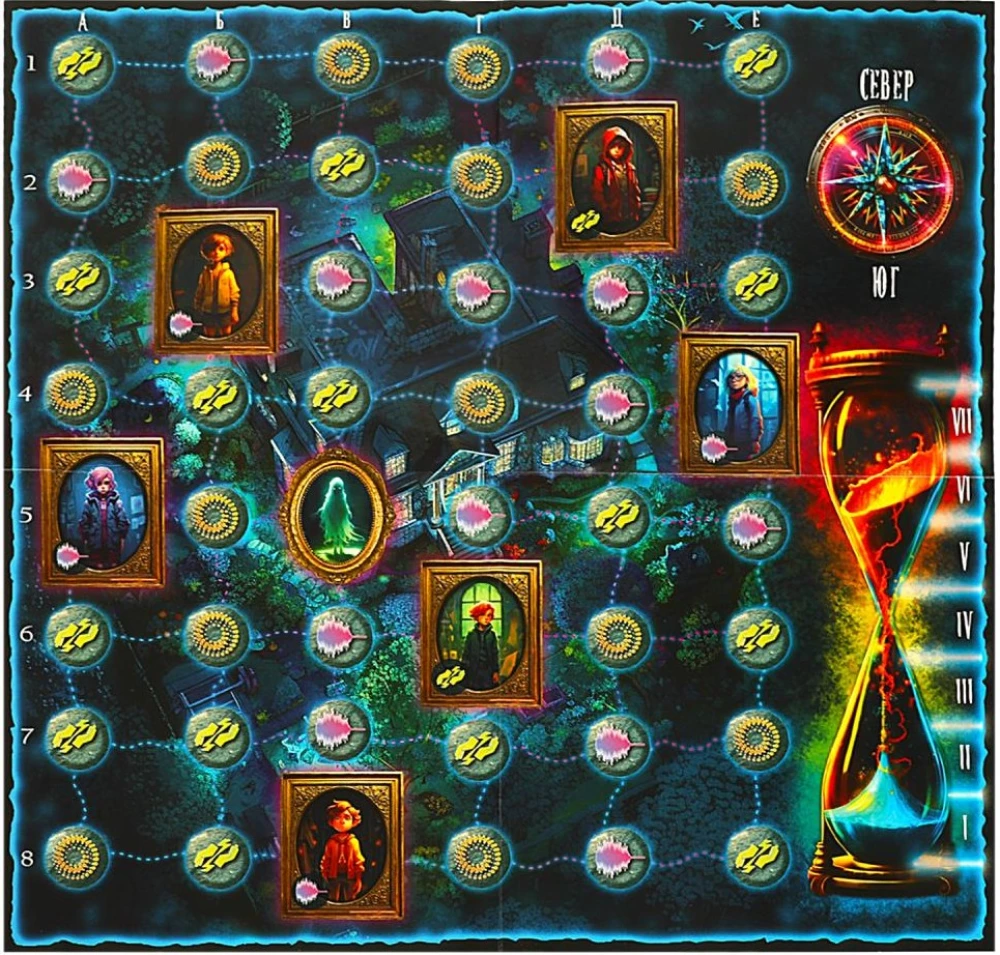
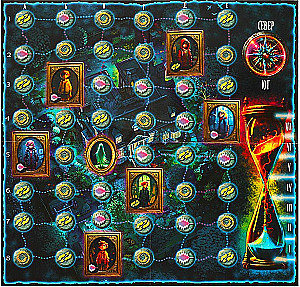
Decide who among the players will play the role of the Phantom: this means the other players will act against it as hunters. The player playing the Phantom sits on the southern side of the board (according to the compass on it), takes 2 cards with the map of the game board, and hides them from the other players in any convenient way (for this, you can use, for example, the lid of the game box). After that, the Phantom selects any token of their choice and places it on the yellow triangle on their map. The triangle corresponds to the Phantom's image on the game board – its starting cell. The Phantom also takes 20 mini-cards "Phantom Move".
The hunter players secretly take one "Hunter" card each, and then read aloud the text on the back of their cards, paying attention to the special abilities of the characters. Then the players choose their tokens and place them on the portraits of the selected heroes on the game board. If you are playing with two players, let the hunter player choose two tokens and two heroes, and on their turn execute actions for both.
Place the "Time" token on mark I of the corresponding scale on the game board. The other tokens and cards are placed nearby.
Game Play:
The game can last a maximum of 7 rounds, which can be tracked by moving the "Time" token along the scale. Each round consists of 2 phases: Twilight and Midnight.
Phase I. Twilight
In Twilight, the Phantom and the hunters prepare to act. The right to choose action cards first is given to the Phantom. The action cards are placed face up with the black frame up, describing the possible actions of the Phantom: "Summon Entity" (Shadows, Poltergeist, Slime), "Horror" or "Acceleration". The Phantom can openly choose 4 cards – or take a risk and roll the dice to gain cards totaling 1 + the dice result (from 2 to 7). The Phantom cannot choose more than 3 "Summon Entity" action cards at the same time. The remaining cards are taken by the hunters. The hunters flip them over with the white frame up, where their available actions are described: "Pentagram", "Trap" and "Acceleration".
Phase II. Midnight
At Midnight, the hunters confront the Phantom. The Phantom plays first. Their movements are hidden from the hunters: they move their token not on the common game board, but on their additional map. The Phantom must make two moves and manage to hide from their starting cell before the hunters begin to move. In these first two moves, the Phantom must not reveal themselves. The Phantom (and the hunters as well) cannot move diagonally.
On their turn, the Phantom rolls the dice and, depending on the number on it, can play a certain number of "Phantom Move" cards to move. The Phantom can play fewer "Phantom Move" cards than the number rolled on the dice, but not more. The Phantom can also choose not to move on their turn. To play a "Phantom Move" card, the Phantom lays it face down next to the game board and moves their token one cell in the direction depicted on the card – on their own hidden game board. The Phantom should also remember their route. If memorizing is not possible, you may need a notebook and pencil for notes. After moving, the Phantom may play one or several of their action cards. One of the most valuable action cards is "Summon Entity". Note: the type of assistant the Phantom can summon depends on the type of cell the Phantom is on.
The Phantom’s starting cell has the properties of all cells and allows summoning all types of entities.
The goal of the Phantom is to reach the cell of one of the relics (starting cells in ancient frames) and destroy it by placing 1 "Damage" token on the corresponding cell of the game board. By destroying a relic, the Phantom moves their token from the hidden map to the main game board, thus revealing themselves until their next turn. After the Phantom is revealed, all "Phantom Move" cards laid out by them prior are discarded. Summoned entities can also destroy relics, but they must be in cells with them for 2 consecutive moves. The Phantom can summon only one entity per turn. Important! The dice roll at the start of the Phantom’s turn determines the total number of steps for the movement of both the Phantom and all summoned entities.
After the Phantom, the Hunters take their turn. Since for them the game is cooperative, they can play cards and move in any order from turn to turn. The hunters' task is to track down the Phantom, catch it, and banish it before it reaches the next relic. The hunters also need to prevent attacks from entities.
On their turn, each hunter rolls the dice and moves their token any number of moves from 1 to the number rolled on the dice. On their turn, a hunter cannot stay in place. After completing the movement, the hunter looks for the Phantom's trail. If in this round the Phantom's route passed through the cell where the hunter stands at the end of their turn, the Phantom must place a "Trail" token on that cell. The hunter can also use a "Pentagram" card to force the Phantom to leave "Trail" tokens in one cell in the vertical, horizontal, and diagonal directions around it. To destroy the pentagram, the Phantom (while revealed) or the entities need only 1 attack.
The hunter has two ways to banish the Phantom. First, a hunter who guesses where the Phantom is located must stand on the same cell and vocally state their guess to the Phantom. If the Phantom is indeed on that cell, they gain 1 level of Banishment and place 1 "Damage" token next to them. If the hunter is wrong, they lose their turn. If the hunter doubts the Phantom's honesty and wants to check them, they can reveal all "Phantom Move" cards laid out by the Phantom during that turn. The hunter loses all action cards if their suspicions turn out to be unfounded. If the suspicions are justified, the Phantom receives 4 "Damage" tokens. If the Phantom accumulates 7 "Damage" tokens, they lose and are considered banished. To banish entities, the hunters only need to stand on the same cell with them.
Second, the hunter can trap the Phantom by playing the "Trap" action card. To do this, the hunter lays the card before them and secretly places two "Trap" tokens under it with the letter and number indicating the specific cell on the board. When the trap is triggered, the hunter confirms its location with the laid tokens. Traps cannot be placed on cells with relics. Entities passing through a cell with a trap are also banished.
The phase ends when the Phantom runs out of suitable "Phantom Move" cards in hand, and they announce the end of the round. The hunters may take their last turn. After this, all traps, pentagrams, and entities are removed from the board, players move the "Time" token up one mark, and begin a new round.
Ending the Game:
For the hunters to win, they must either banish the Phantom before it destroys all 6 relics, or survive 7 rounds by fending off the Phantom's attacks and preventing it and the summoned entities from reaching the relics. For the Phantom to win, it must confuse the hunters and destroy all 6 relics on the board before the 7 rounds come to an end.
Game Components:
- game board;
- 4 tokens and a dice;
- game board schematic (on 2 cards);
- 6 "Hunter" cards;
- 13 action cards;
- 20 mini-cards "Phantom Move";
- 14 "Damage" tokens;
- 12 "Trail" tokens;
- 14 "Trap" tokens;
- 4 "Pentagram" tokens;
- 6 "Entity" tokens;
- "Time" token.
Number of Players: 2-4
Game Time: from 30 minutes
Game Objective:
The goal of the hunters is to banish the Phantom within 7 game days, preventing it from destroying all relics. The goal of the Phantom is to destroy 6 relics in the same timeframe, avoiding banishment.
Game Setup:
Decide who among the players will play the role of the Phantom: this means the other players will act against it as hunters. The player playing the Phantom sits on the southern side of the board (according to the compass on it), takes 2 cards with the map of the game board, and hides them from the other players in any convenient way (for this, you can use, for example, the lid of the game box). After that, the Phantom selects any token of their choice and places it on the yellow triangle on their map. The triangle corresponds to the Phantom's image on the game board – its starting cell. The Phantom also takes 20 mini-cards "Phantom Move".
The hunter players secretly take one "Hunter" card each, and then read aloud the text on the back of their cards, paying attention to the special abilities of the characters. Then the players choose their tokens and place them on the portraits of the selected heroes on the game board. If you are playing with two players, let the hunter player choose two tokens and two heroes, and on their turn execute actions for both.
Place the "Time" token on mark I of the corresponding scale on the game board. The other tokens and cards are placed nearby.
Game Play:
The game can last a maximum of 7 rounds, which can be tracked by moving the "Time" token along the scale. Each round consists of 2 phases: Twilight and Midnight.
Phase I. Twilight
In Twilight, the Phantom and the hunters prepare to act. The right to choose action cards first is given to the Phantom. The action cards are placed face up with the black frame up, describing the possible actions of the Phantom: "Summon Entity" (Shadows, Poltergeist, Slime), "Horror" or "Acceleration". The Phantom can openly choose 4 cards – or take a risk and roll the dice to gain cards totaling 1 + the dice result (from 2 to 7). The Phantom cannot choose more than 3 "Summon Entity" action cards at the same time. The remaining cards are taken by the hunters. The hunters flip them over with the white frame up, where their available actions are described: "Pentagram", "Trap" and "Acceleration".
Phase II. Midnight
At Midnight, the hunters confront the Phantom. The Phantom plays first. Their movements are hidden from the hunters: they move their token not on the common game board, but on their additional map. The Phantom must make two moves and manage to hide from their starting cell before the hunters begin to move. In these first two moves, the Phantom must not reveal themselves. The Phantom (and the hunters as well) cannot move diagonally.
On their turn, the Phantom rolls the dice and, depending on the number on it, can play a certain number of "Phantom Move" cards to move. The Phantom can play fewer "Phantom Move" cards than the number rolled on the dice, but not more. The Phantom can also choose not to move on their turn. To play a "Phantom Move" card, the Phantom lays it face down next to the game board and moves their token one cell in the direction depicted on the card – on their own hidden game board. The Phantom should also remember their route. If memorizing is not possible, you may need a notebook and pencil for notes. After moving, the Phantom may play one or several of their action cards. One of the most valuable action cards is "Summon Entity". Note: the type of assistant the Phantom can summon depends on the type of cell the Phantom is on.
The Phantom’s starting cell has the properties of all cells and allows summoning all types of entities.
The goal of the Phantom is to reach the cell of one of the relics (starting cells in ancient frames) and destroy it by placing 1 "Damage" token on the corresponding cell of the game board. By destroying a relic, the Phantom moves their token from the hidden map to the main game board, thus revealing themselves until their next turn. After the Phantom is revealed, all "Phantom Move" cards laid out by them prior are discarded. Summoned entities can also destroy relics, but they must be in cells with them for 2 consecutive moves. The Phantom can summon only one entity per turn. Important! The dice roll at the start of the Phantom’s turn determines the total number of steps for the movement of both the Phantom and all summoned entities.
After the Phantom, the Hunters take their turn. Since for them the game is cooperative, they can play cards and move in any order from turn to turn. The hunters' task is to track down the Phantom, catch it, and banish it before it reaches the next relic. The hunters also need to prevent attacks from entities.
On their turn, each hunter rolls the dice and moves their token any number of moves from 1 to the number rolled on the dice. On their turn, a hunter cannot stay in place. After completing the movement, the hunter looks for the Phantom's trail. If in this round the Phantom's route passed through the cell where the hunter stands at the end of their turn, the Phantom must place a "Trail" token on that cell. The hunter can also use a "Pentagram" card to force the Phantom to leave "Trail" tokens in one cell in the vertical, horizontal, and diagonal directions around it. To destroy the pentagram, the Phantom (while revealed) or the entities need only 1 attack.
The hunter has two ways to banish the Phantom. First, a hunter who guesses where the Phantom is located must stand on the same cell and vocally state their guess to the Phantom. If the Phantom is indeed on that cell, they gain 1 level of Banishment and place 1 "Damage" token next to them. If the hunter is wrong, they lose their turn. If the hunter doubts the Phantom's honesty and wants to check them, they can reveal all "Phantom Move" cards laid out by the Phantom during that turn. The hunter loses all action cards if their suspicions turn out to be unfounded. If the suspicions are justified, the Phantom receives 4 "Damage" tokens. If the Phantom accumulates 7 "Damage" tokens, they lose and are considered banished. To banish entities, the hunters only need to stand on the same cell with them.
Second, the hunter can trap the Phantom by playing the "Trap" action card. To do this, the hunter lays the card before them and secretly places two "Trap" tokens under it with the letter and number indicating the specific cell on the board. When the trap is triggered, the hunter confirms its location with the laid tokens. Traps cannot be placed on cells with relics. Entities passing through a cell with a trap are also banished.
The phase ends when the Phantom runs out of suitable "Phantom Move" cards in hand, and they announce the end of the round. The hunters may take their last turn. After this, all traps, pentagrams, and entities are removed from the board, players move the "Time" token up one mark, and begin a new round.
Ending the Game:
For the hunters to win, they must either banish the Phantom before it destroys all 6 relics, or survive 7 rounds by fending off the Phantom's attacks and preventing it and the summoned entities from reaching the relics. For the Phantom to win, it must confuse the hunters and destroy all 6 relics on the board before the 7 rounds come to an end.
Game Components:
- game board;
- 4 tokens and a dice;
- game board schematic (on 2 cards);
- 6 "Hunter" cards;
- 13 action cards;
- 20 mini-cards "Phantom Move";
- 14 "Damage" tokens;
- 12 "Trail" tokens;
- 14 "Trap" tokens;
- 4 "Pentagram" tokens;
- 6 "Entity" tokens;
- "Time" token.
Number of Players: 2-4
Game Time: from 30 minutes
Series: 359289
Age restrictions: 8+
EAN: 4660254400672
Size: 250х250х55 mm
Weight: 380 g
ID: 1730022
In stock
€ 6.49
Will be delivered to United States on :
Unfortunately, we are currently unable to deliver orders to your region.
In stock
€ 6.49
Will be delivered to United States on :
Unfortunately, we are currently unable to deliver orders to your region.