New













The Man from the Small Apartment. Nothing Good
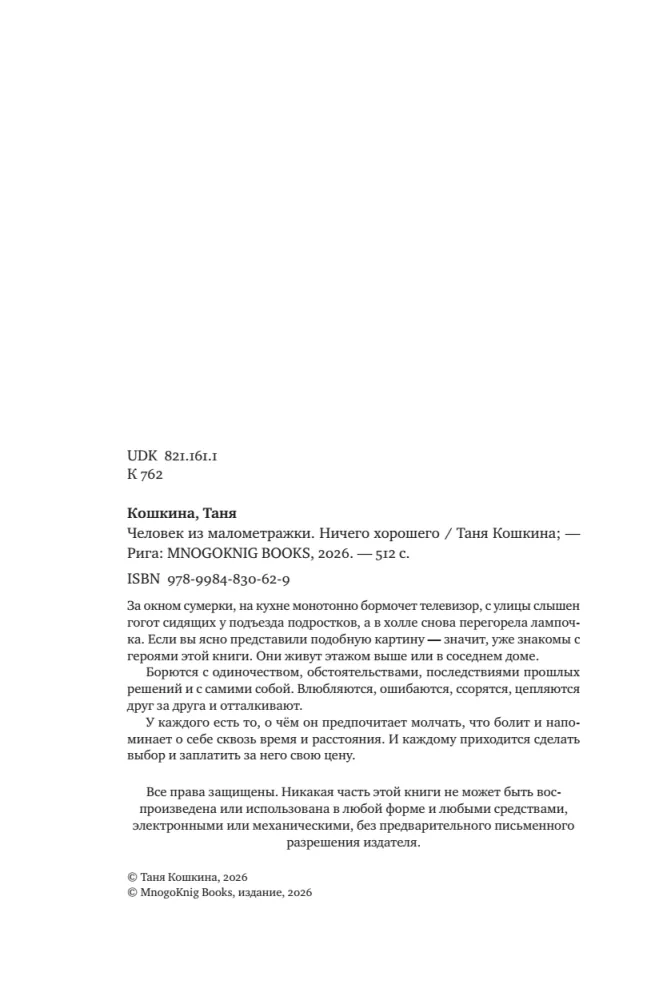
Outside, it's twilight, the television monotonously murmurs in the kitchen, the laughter of teenagers sitting by the entrance can be heard from the street, and the light bulb in the hallway has burned out again. If you clearly imagined such...
a picture — you are already familiar with the characters of this book. They live one floor above or in the neighboring house.
They struggle with loneliness, circumstances, the consequences of past decisions, and with themselves. They fall in love, make mistakes, quarrel, cling to each other, and push each other away.
Each has something they prefer to remain silent about, something that hurts and reminds them of itself through time and distance. And each has to make a choice and pay their price for it.
«The Man from the Small Apartment» — a book that does not try to please. Formally, this story can be classified as a contemporary romance or psychological drama, but such labels turn out to be too narrow. Before us is a text that speaks not so much about love as about dependence — as a state in which a person exists, breathes, builds connections, and destroys them.
Max — a former drug addict, a person with experience of falling and attempts to stay afloat. He lives in a state of constant balance: between sobriety and relapse, between external «normality» and internal emptiness, between the desire to live and the habit of self-destruction. Lera, at first glance, is opposed to Max. She is younger, outwardly cleaner, less broken. But as the story unfolds, it becomes clear that her dependence is no less destructive. Only the form is different — emotional.
Their relationship does not become a path to healing. Traumas collide, amplify each other, sometimes temporarily dull, but do not disappear. This is not a story about how love saves, but a story about how people use closeness to avoid being alone with themselves.
The language of the novel is devoid of embellishment. Entrances, car services, small apartments, provincial streets — all this is not just scenery, but a continuation of the inner state of the characters. There is a lingering sense of cyclicality, an understanding that falling does not always look like a sharp drop, but more often like a slow slide.
At the same time, the author does not take a moralizing position. There are no villains in the usual sense and no saviors. There are people, each of whom has not coped with life in their own way.
This is not a book for light reading and not for escaping reality. But for those who are ready to look at a person without illusions, it can become a rare and important experience.
«Nothing Good» — a very intimate, quiet, and yet painfully honest story about a person who has found themselves on the edge.
There is no grand plot or attempt to surprise the reader with events. On the contrary, the book captivates with its groundedness and sense of reality. It seems as if this story is happening somewhere very close: in the neighboring entrance, in a stranger's apartment with a smoky kitchen and sleepless nights.
The main strength of the story — its internal state. The author shows the slow destruction of a person from within: feelings of guilt, accumulated pain, fatigue from life and from oneself. The theme of human participation is particularly strong here. That very participation, which sometimes irritates, seems unnecessary and even painful, but it is precisely this that ultimately becomes the only thing capable of keeping a person from falling completely.
The characters feel alive: with their weaknesses, awkwardness, rudeness, and attempts to support each other in any way. There are no perfect people or beautiful rescues — everything looks as it does in life. That is why the story works emotionally.
Despite the rather heavy atmosphere, the story does not leave a sense of hopelessness. On the contrary, behind all this darkness, light begins to be felt gradually. Not loud and pompous, but quiet, human.
And perhaps it is precisely because of this that «Nothing Good» is perceived not just as a grim story about pain, but as a very honest conversation about a person who is still trying to live on.
They struggle with loneliness, circumstances, the consequences of past decisions, and with themselves. They fall in love, make mistakes, quarrel, cling to each other, and push each other away.
Each has something they prefer to remain silent about, something that hurts and reminds them of itself through time and distance. And each has to make a choice and pay their price for it.
«The Man from the Small Apartment» — a book that does not try to please. Formally, this story can be classified as a contemporary romance or psychological drama, but such labels turn out to be too narrow. Before us is a text that speaks not so much about love as about dependence — as a state in which a person exists, breathes, builds connections, and destroys them.
Max — a former drug addict, a person with experience of falling and attempts to stay afloat. He lives in a state of constant balance: between sobriety and relapse, between external «normality» and internal emptiness, between the desire to live and the habit of self-destruction. Lera, at first glance, is opposed to Max. She is younger, outwardly cleaner, less broken. But as the story unfolds, it becomes clear that her dependence is no less destructive. Only the form is different — emotional.
Their relationship does not become a path to healing. Traumas collide, amplify each other, sometimes temporarily dull, but do not disappear. This is not a story about how love saves, but a story about how people use closeness to avoid being alone with themselves.
The language of the novel is devoid of embellishment. Entrances, car services, small apartments, provincial streets — all this is not just scenery, but a continuation of the inner state of the characters. There is a lingering sense of cyclicality, an understanding that falling does not always look like a sharp drop, but more often like a slow slide.
At the same time, the author does not take a moralizing position. There are no villains in the usual sense and no saviors. There are people, each of whom has not coped with life in their own way.
This is not a book for light reading and not for escaping reality. But for those who are ready to look at a person without illusions, it can become a rare and important experience.
«Nothing Good» — a very intimate, quiet, and yet painfully honest story about a person who has found themselves on the edge.
There is no grand plot or attempt to surprise the reader with events. On the contrary, the book captivates with its groundedness and sense of reality. It seems as if this story is happening somewhere very close: in the neighboring entrance, in a stranger's apartment with a smoky kitchen and sleepless nights.
The main strength of the story — its internal state. The author shows the slow destruction of a person from within: feelings of guilt, accumulated pain, fatigue from life and from oneself. The theme of human participation is particularly strong here. That very participation, which sometimes irritates, seems unnecessary and even painful, but it is precisely this that ultimately becomes the only thing capable of keeping a person from falling completely.
The characters feel alive: with their weaknesses, awkwardness, rudeness, and attempts to support each other in any way. There are no perfect people or beautiful rescues — everything looks as it does in life. That is why the story works emotionally.
Despite the rather heavy atmosphere, the story does not leave a sense of hopelessness. On the contrary, behind all this darkness, light begins to be felt gradually. Not loud and pompous, but quiet, human.
And perhaps it is precisely because of this that «Nothing Good» is perceived not just as a grim story about pain, but as a very honest conversation about a person who is still trying to live on.
Author: Таня Кошкина
Age restrictions: 18+
Year of publication: 2026
ISBN: 9789984830629
Number of pages: 500
Size: 210х140х20 mm
Cover type: soft
Weight: 799 g
ID: 1748489
In stock
€ 17.00
Will be delivered to United States on 22 September (Tu):
By courier
from € 38.94
Bestsellers









Bestseller
€ 12.19
In stock
Kanashibari. Until the Last Lantern Goes Out. Volume 1
Ангелина Шэн, Вероника Шэн