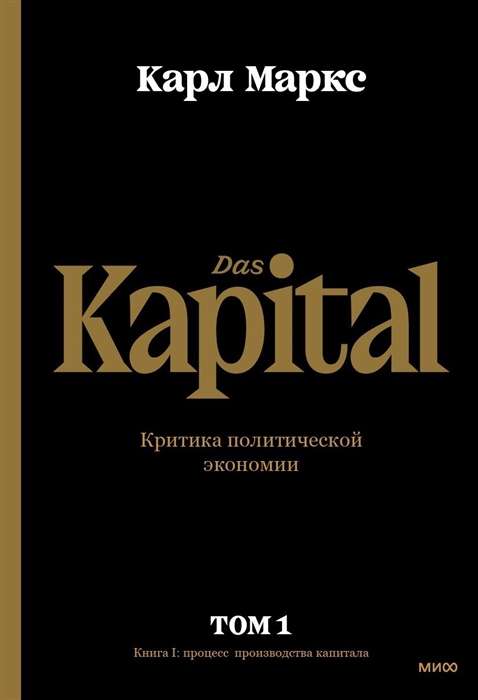
Capital. Critique of Political Economy. Volume One. Book I: The Process of Capital Production
"Capital" by Karl Marx is truly a great book. It has been translated into more than 50 languages and has been reprinted over 220 times. At the time, this work not only revolutionized economic science but also, indirectly, the entire...
world order, because it revealed the mechanism by which money, accumulating into capital, subjugates human society. Since then, interest in "Capital" has not waned. Remarkably, in the 19th century, the realities of our time were predicted: deep recessions, the formation of illusory needs, globalization, automation of production with resulting unemployment. And if you want to understand how abstract capital governs your real life, it is worth reading Marx's work in its complete version. In the first volume ("The Process of Capital Production," 1867), concepts of commodity, labor power, value, including surplus value, are introduced and it shows how wage labor forms capital, which in turn transforms into an invisible force that stratifies society and creates the ground for social upheavals. For a better understanding of the historical and philosophical context of the era, some other works by Marx and his contemporaries are included in the first volume.
Author: КАРЛ МАРКС
Printhouse: Mann, Ivanov i Ferber
Series: Economics. Classical Works
Age restrictions: 16+
Year of publication: 2023
ISBN: 9785001955993
Number of pages: 1200
Size: 24.1 x 16.8 x 6.2 mm
Cover type: Твёрдая обложка
Weight: 500 g
ID: 1448640
Sold out
€ 27.79
Sold out
€ 27.79