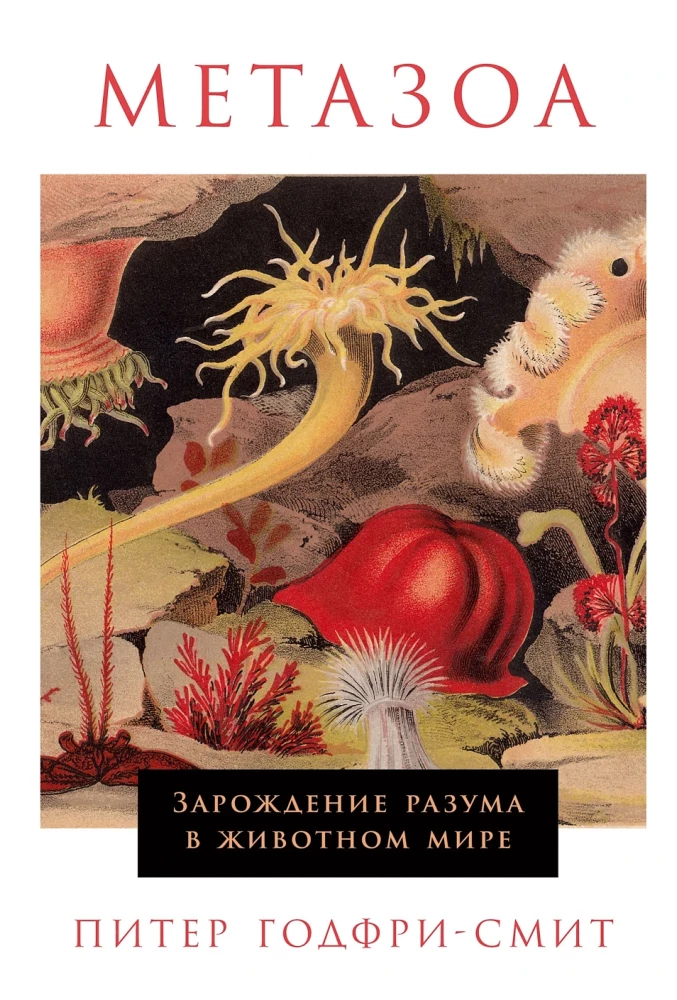
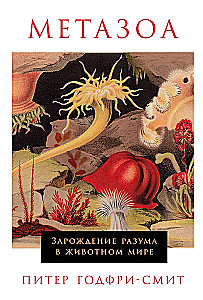
Metazoa. The Birth of Mind in the Animal World
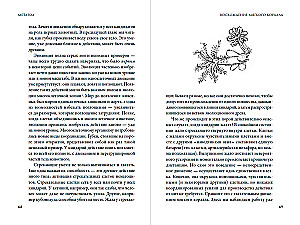
As soon as a diver plunges into the sea, he encounters life forms that seem extraordinarily alien: there are sea sponges, soft corals, and serpulid worms, whose bizarre bodies, intricate structures, and flower-like appendages resemble plants or even architectural forms...
more than they do animals. Nevertheless, all these creatures are our relatives. As equal representatives of the animal kingdom—metazoa—they can tell us a lot about the evolutionary origins not only of the human body but also of consciousness. Trying to immerse ourselves in their experience and understand what it's like to perceive the world and interact with it as other living beings do, Peter Godfrey-Smith shows that the typical animal body, which appeared more than half a billion years ago, became the very innovation that directed life along a fundamentally different path. By tracing the emergence of sponges, corals, shrimp, octopuses, and fish through natural selection, and then moving onto land into the world of insects, birds, and primates, 'Metazoa' overcomes the gap between mind and matter, bringing us closer to resolving one of the deepest philosophical problems—the problem of consciousness. Trying to immerse ourselves in their experience and understand what it's like to perceive the world and interact with it as other living beings do, Peter Godfrey-Smith shows that the typical animal body, which appeared more than half a billion years ago, became the very innovation that directed life along a fundamentally different path. By tracing the emergence of sponges, corals, shrimp, octopuses, and fish through natural selection, and then moving onto land into the world of insects, birds, and primates, 'Metazoa' overcomes the gap between mind and matter, bringing us closer to resolving one of the deepest philosophical problems—the problem of consciousness.
Author: Питер Годфри-Смит
Printhouse: Al'pina Pablisher
Series: General Biology
Age restrictions: 16+
Year of publication: 2023
ISBN: 9785001398653
Number of pages: 416
Size: 216х146х27 mm
Cover type: hard
Weight: 600 g
ID: 1411736
In stock
€ 10.89
Will be delivered to United States on 30 June (Tu):
By courier
from € 38.94
Bestsellers









€ 5.19
In stock




€ 9.29
In stock
Choice. On the Freedom and Inner Strength of a Person
Эдит Ева Эгер, Эсме Швалль-Вейганд

Publishers "Al'pina Pablisher" recommends


Bestseller
€ 9.49
In stock
The Happy Union. The Seven Habits of Highly Effective Couples
КОВИ СТИВЕН Р., КОВИ ДЖОН