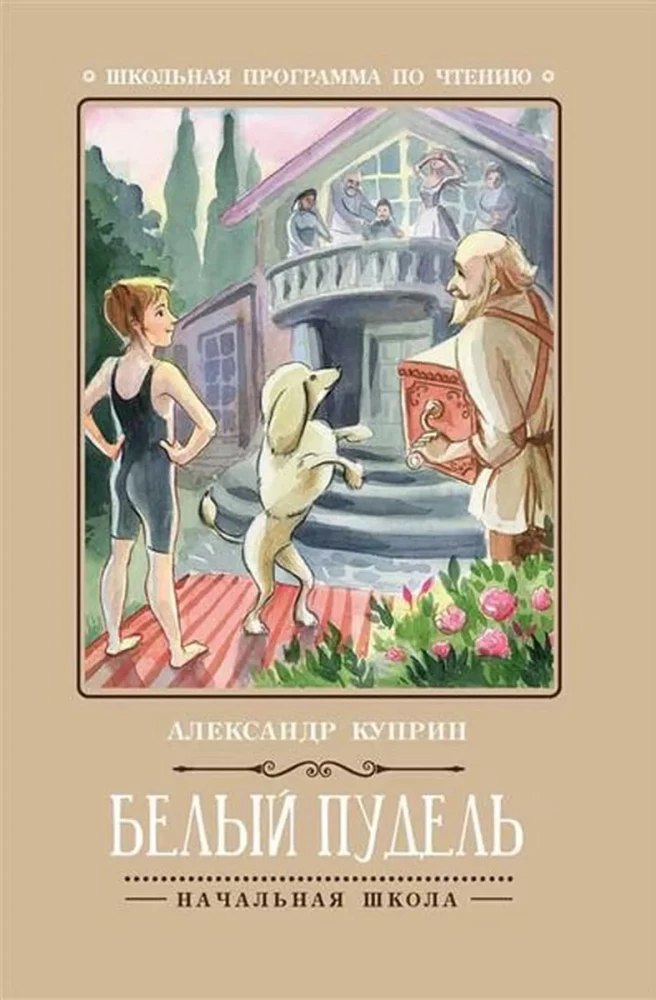
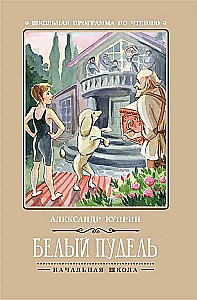
White Poodle
Alexander Ivanovich Kuprin (1870–1938) was an outstanding Russian realist writer. He was born in a small provincial town of Narovchat (now in the Penza region) into a family of hereditary nobles. The future writer's father passed away in 1871, a...
year after his son's birth. Hard times came for the family, and his mother was forced to send the boy to an orphanage. In 1880, Kuprin entered the Second Moscow Military Gymnasium, and in 1887 he enrolled in the Alexandrov Military School. From 1890 to 1894, Alexander Ivanovich served as a second lieutenant in the 46th Dnieper Regiment in the Podolsk province. He retired in 1894 and moved to Kiev. He had no civil profession and, before taking to the pen, he changed many jobs. A.I. Kuprin was a curious person, eager to try himself in various roles. He jokingly told his friends that he "would like to become a horse, a plant, or a fish for a few days."
His first work, the short story "The Last Debut," was published in 1889 when he was a student at the military school. When his superiors found out about it, Kuprin was put in solitary confinement for two days. At that time, he swore to himself to abandon literary pursuits and not to touch pen and paper. However, acquaintance with Bunin, Chekhov, and Gorky in the late 1890s made him forget this vow. In 1901, A.I. Kuprin moved to St. Petersburg and began working as a secretary for the "Journal for All." By this time, the reading public had duly appreciated his literary talent, and the novella "The Duel," published in 1905, finally cemented his reputation as a master of the word.
The plot of the story "White Poodle" is based on real events; the writer was personally acquainted with this group of artists. The story told by Seryozha deeply moved A.I. Kuprin. In this simple plot, two important themes for the writer are designated - the theme of social inequality and the theme of relationships between humans and animals. The author very clearly contrasts the behavior of Seryozha and Trilli. The son of the landlady is clumsy and spoiled, indifferent to nature, while Seryozha is nimble, strong, and resolute. The young artist does not even think of leaving his four-legged friend in trouble; for Trilli, only his own needs exist, and he does not even ponder the feelings and desires of others.
His first work, the short story "The Last Debut," was published in 1889 when he was a student at the military school. When his superiors found out about it, Kuprin was put in solitary confinement for two days. At that time, he swore to himself to abandon literary pursuits and not to touch pen and paper. However, acquaintance with Bunin, Chekhov, and Gorky in the late 1890s made him forget this vow. In 1901, A.I. Kuprin moved to St. Petersburg and began working as a secretary for the "Journal for All." By this time, the reading public had duly appreciated his literary talent, and the novella "The Duel," published in 1905, finally cemented his reputation as a master of the word.
The plot of the story "White Poodle" is based on real events; the writer was personally acquainted with this group of artists. The story told by Seryozha deeply moved A.I. Kuprin. In this simple plot, two important themes for the writer are designated - the theme of social inequality and the theme of relationships between humans and animals. The author very clearly contrasts the behavior of Seryozha and Trilli. The son of the landlady is clumsy and spoiled, indifferent to nature, while Seryozha is nimble, strong, and resolute. The young artist does not even think of leaving his four-legged friend in trouble; for Trilli, only his own needs exist, and he does not even ponder the feelings and desires of others.
Author: Александр Куприн
Printhouse: Feniks
Series: School Reading Program
Age restrictions: 0+
Year of publication: 2026
ISBN: 9785222461846
Number of pages: 96
Size: 208x140x4 mm
Cover type: soft
Weight: 102 g
ID: 1731365
In stock
€ 3.29
Will be delivered to United States on 24 August (Mo):
By courier
from € 38.94
Bestsellers






€ 9.59
In stock