



Narrative Economics. The New Science of How Viral Stories Influence Economic Events
The world is ruled not by money, but by stories. About bitcoin, which costs thousands of dollars because people believe in it. About giant companies that "cannot" go bankrupt. About stock prices that "will definitely" crash next month.
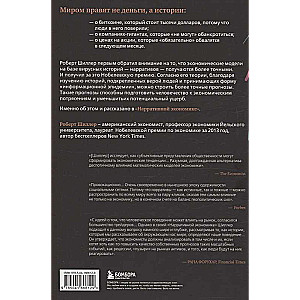
Robert Shiller was... the first to notice that economic models based on viral stories – narratives – become more accurate. And for this, he received the Nobel Prize. According to his theory, by studying stories backed by people's beliefs and taking the form of an "information epidemic," more accurate forecasts can be made. Such forecasts can prepare humanity for economic shocks and reduce their potential damage.
This is precisely what is discussed in "Narrative Economics."
Robert Shiller is an American economist, professor of economics at Yale University, and the 2013 Nobel laureate in economics, author of New York Times bestsellers.
"[Shiller] explores how public perceptions can shape economic trends... A sensible, long-awaited alternative to the despotic influence of mathematical models of economics." — The Economist
"Provocative... Very timely in this era of social media obsession. Because narratives – both true and false – can be spread around the world at the click of a button, thereby influencing not only the economy, but ultimately the balance of geopolitical power." — MATT SHIFRIN and ANNA CORRADY, Forbes
"Most traders will agree with the idea that human behavior can influence the market... However, in his 'Narrative Economics,' Shiller approaches this issue much more broadly and deeply, examining how the stories we tell about the world around us shape our behavior... He argues that economists must analyze these as well if they want to improve the quality of their forecasts of large-scale events such as recessions, asset market 'bubbles,' and how people will react to them." — RANA FOROuhAR, Financial Times
Robert Shiller was... the first to notice that economic models based on viral stories – narratives – become more accurate. And for this, he received the Nobel Prize. According to his theory, by studying stories backed by people's beliefs and taking the form of an "information epidemic," more accurate forecasts can be made. Such forecasts can prepare humanity for economic shocks and reduce their potential damage.
This is precisely what is discussed in "Narrative Economics."
Robert Shiller is an American economist, professor of economics at Yale University, and the 2013 Nobel laureate in economics, author of New York Times bestsellers.
"[Shiller] explores how public perceptions can shape economic trends... A sensible, long-awaited alternative to the despotic influence of mathematical models of economics." — The Economist
"Provocative... Very timely in this era of social media obsession. Because narratives – both true and false – can be spread around the world at the click of a button, thereby influencing not only the economy, but ultimately the balance of geopolitical power." — MATT SHIFRIN and ANNA CORRADY, Forbes
"Most traders will agree with the idea that human behavior can influence the market... However, in his 'Narrative Economics,' Shiller approaches this issue much more broadly and deeply, examining how the stories we tell about the world around us shape our behavior... He argues that economists must analyze these as well if they want to improve the quality of their forecasts of large-scale events such as recessions, asset market 'bubbles,' and how people will react to them." — RANA FOROuhAR, Financial Times
Author: ШИЛЛЕР Р.
Printhouse: Eksmo
Series: Top Economics Awards
Age restrictions: 16+
Year of publication: 2024
ISBN: 9785041866129
Number of pages: 416
Size: 250x170x27 mm
Cover type: hard
Weight: 674 g
ID: 1631992
Sold out
€ 18.09
Sold out
€ 18.09
Bestsellers







Bestseller
€ 12.19
In stock
Kanashibari. Until the Last Lantern Goes Out. Volume 1
Ангелина Шэн, Вероника Шэн