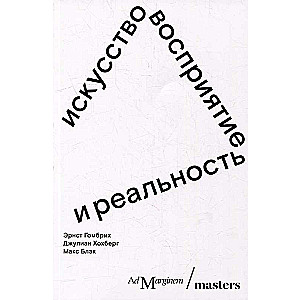
In this book, dedicated to the nature of visual perception in art, the opinions of three outstanding scholars collide. Art historian Ernst Gombrich, drawing our attention to the problem of likeness, particularly in portraits and caricatures, concludes that we, often...
unable to describe the features of even the closest people, easily find similarity through empathy. Psychologist Julian Hochberg gently counters this argument with his theory of canonical forms of objects, suggesting that we perceive similarity through "cognitive maps" or expectations that arise in the complex process of visual perception, as our eye glides over the surface of the painting in a predetermined sequence. Finally, philosopher Max Black, through conceptual analysis of these and other approaches to visual perception, argues that there are neither sufficient nor necessary criteria for determining the conditions of artistic representation, concluding that artistic representation is a "cluster concept". The essays presented here are based on the Talheimer public lectures delivered by the authors at the philosophy department of Johns Hopkins University in the 1970s.
In this book, dedicated to the nature of visual perception in art, the opinions of three outstanding scholars collide. Art historian Ernst Gombrich, drawing our attention to the problem of likeness, particularly in portraits and caricatures, concludes that we, often unable to describe the features of even the closest people, easily find similarity through empathy. Psychologist Julian Hochberg gently counters this argument with his theory of canonical forms of objects, suggesting that we perceive similarity through "cognitive maps" or expectations that arise in the complex process of visual perception, as our eye glides over the surface of the painting in a predetermined sequence. Finally, philosopher Max Black, through conceptual analysis of these and other approaches to visual perception, argues that there are neither sufficient nor necessary criteria for determining the conditions of artistic representation, concluding that artistic representation is a "cluster concept". The essays presented here are based on the Talheimer public lectures delivered by the authors at the philosophy department of Johns Hopkins University in the 1970s.
Be the first to know about our current discounts, offers and new products!
Check icon
You have added to your basket
Check icon
You have added to favourites
Sold out
The item is currently out of stock.
In stock
Available in warehouse. You will receive the exact delivery date from the operator after the order confirmation.
To order
The product is delivered directly from the publisher. The order processing time is up to 14 days, you will receive the exact delivery date from the operator after the order confirmation.