




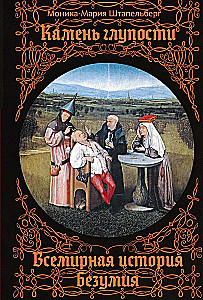





The Stone of Stupidity: A Global History of Madness
Who can be considered a madman? Throughout history, this question has been answered differently. Psychiatry as a distinct field emerged in the mid-19th century, uniting knowledge from previous eras. The sick were considered witches, and later they were housed in...
special institutions that were not known for their humanity. Even kings were not protected from mental disorders. The development of psychiatry went through dark chapters of eugenics and many prejudices. Any mental illness in women was attributed to the reproductive system, masturbation was seen as a source of madness, men were treated with castration, and members of both sexes were subjected to circumcision. In this book, you will meet Hippocrates and Galen, Michel Foucault and George III, and discover new facets of madness. “The perception of mental health and mental illness is vastly different from what it was during the times of early civilizations, and continues to evolve as knowledge and understanding of the human psyche accumulate. Therefore, the term ‘madness’ is merely a distorted representation of the constantly changing, fluctuating social values. For centuries, the concept of madness has reflected the social, cultural, and intellectual structure of society, as well as the mindset of each era, which is the emphasis of this book” (Monika-Maria Stapelberg).
Who can be considered a madman? Throughout history, this question has been answered differently. Psychiatry as a distinct field emerged in the mid-19th century, uniting knowledge from previous eras. The sick were considered witches, and later they were housed in special institutions that were not known for their humanity. Even kings were not protected from mental disorders. The development of psychiatry went through dark chapters of eugenics and many prejudices. Any mental illness in women was attributed to the reproductive system, masturbation was seen as a source of madness, men were treated with castration, and members of both sexes were subjected to circumcision. In this book, you will meet Hippocrates and Galen, Michel Foucault and George III, and discover new facets of madness. “The perception of mental health and mental illness is vastly different from what it was during the times of early civilizations, and continues to evolve as knowledge and understanding of the human psyche accumulate. Therefore, the term ‘madness’ is merely a distorted representation of the constantly changing, fluctuating social values. For centuries, the concept of madness has reflected the social, cultural, and intellectual structure of society, as well as the mindset of each era, which is the emphasis of this book” (Monika-Maria Stapelberg).
Be the first to know about our current discounts, offers and new products!
Check icon
You have added to your basket
Check icon
You have added to favourites
Sold out
The item is currently out of stock.
In stock
Available in warehouse. You will receive the exact delivery date from the operator after the order confirmation.
To order
The product is delivered directly from the publisher. The order processing time is up to 14 days, you will receive the exact delivery date from the operator after the order confirmation.
No circulation
Unfortunately, the print run of the book has ended, it is currently unavailable for order.