


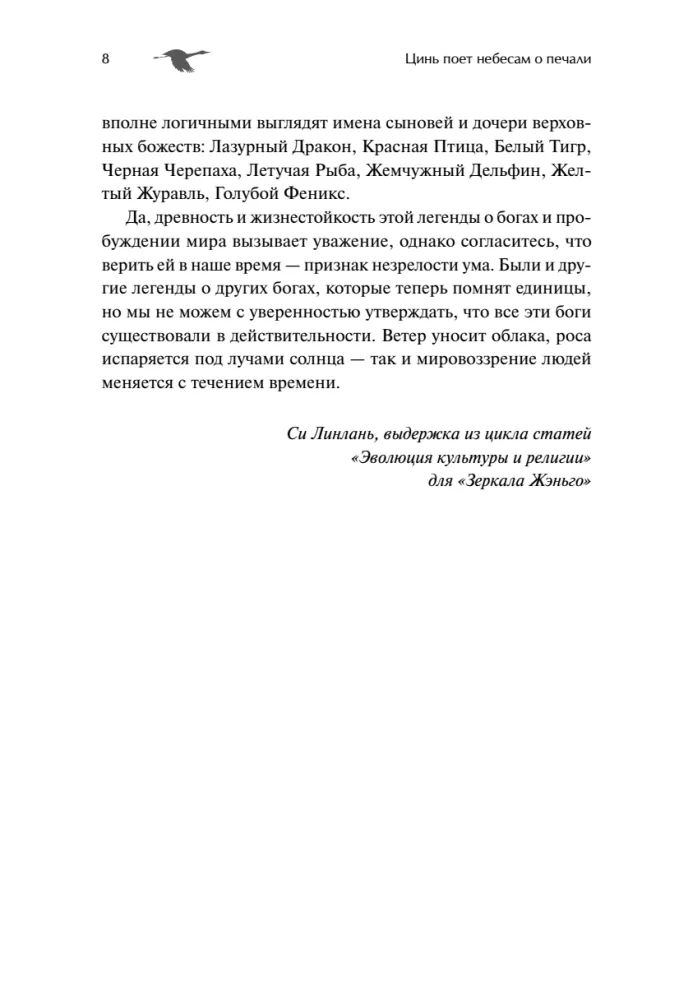
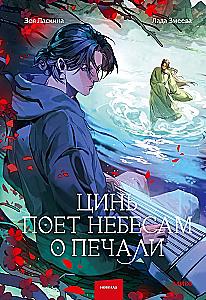
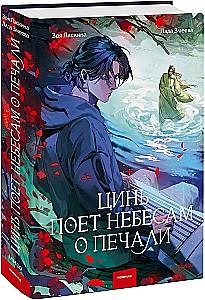


Qin sings to the heavens about sorrow
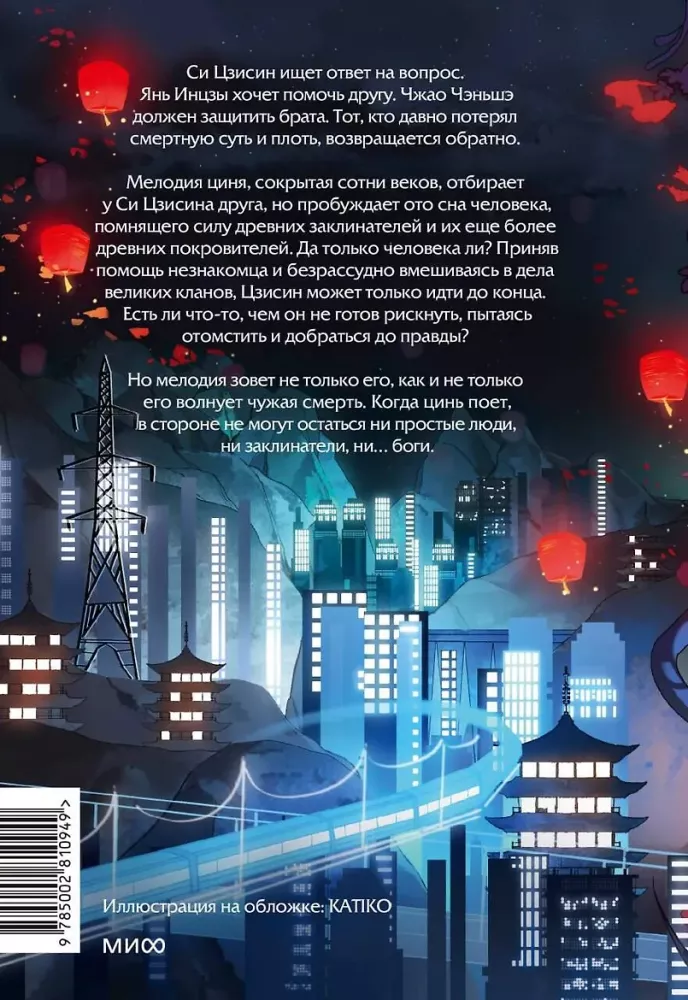
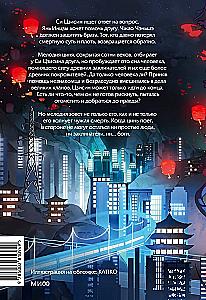
«Qin sings to the heavens about sorrow» — a fantasy set in an alternative modern China, where the melody of an ancient qin draws a young spellcaster into a struggle for truth, memory, and the right to know what has...
been hidden in the past. In Zoe Laskina's book, ordinary people, great clans, spellcasters, and divine patrons coexist, while old crimes continue to affect the living. Here, not only magic and ancient alliances are important, but also the price of loss, loyalty to loved ones, and the willingness to stand against a force that seems incomparably greater than a human. This is a standalone story in a world close in spirit and structure to that of «The Sword in the Plum Blossom Sheath».
After the death of a friend, Si Zixin tries to understand what the ancient melody of the qin has set in motion and why one event leads to a whole chain of silences. By his side is Yan Yinzi, who does not back down even when the search for truth leads to dangerous decisions and interference in the affairs of great clans. Meanwhile, Zhao Chenshe tries to protect his brother and becomes increasingly involved in someone else's conflict, where family loyalty collides with duty and fear. The situation changes with the appearance of a mysterious stranger connected to the memory of ancient spellcasters and their patrons.
Si Zixin — a young spellcaster who seeks not comfort but answers after a personal loss. He is driven by revenge, doubts, and the desire to get to the truth, even if it means risking too much.
Yan Yinzi — a friend and ally who does not stay on the sidelines. He helps in the investigation and becomes a support in a world where every step can draw one into another's war.
Zhao Chenshe — a person for whom protecting his brother is paramount. His arc adds to the story the theme of family duty and the choice between loved ones and clan demands.
The world of the novel combines modernity and ancient mythological layers. Alternative China here operates under laws where spellcasters, old clans, and gods act alongside people, and the past has not gone into legends but continues to interfere with the present. An important image is the qin, an ancient stringed instrument associated with memory, sorrow, and the boundary between the human and the divine. This gives the narrative a chronicle-like feel, where an ancient power suddenly returns to everyday life.
The novel will appeal to those looking for Asian fantasy with a well-thought-out world, clan conflicts, and the theme of hidden truth. It will particularly interest readers who are drawn to stories about spellcasters, family loyalty, and the confrontation of humans with forces that go back to deep antiquity. In terms of mood and cultural support, the text can be compared to «The Sword in the Plum Blossom Sheath», while in attention to mythology and internal conflicts, it aligns with prose in the tradition of Asian fantasy about clans and gods. Here, the center is not only magic but also questions of responsibility for the past, the price of silence, and the right to know the truth.
After the death of a friend, Si Zixin tries to understand what the ancient melody of the qin has set in motion and why one event leads to a whole chain of silences. By his side is Yan Yinzi, who does not back down even when the search for truth leads to dangerous decisions and interference in the affairs of great clans. Meanwhile, Zhao Chenshe tries to protect his brother and becomes increasingly involved in someone else's conflict, where family loyalty collides with duty and fear. The situation changes with the appearance of a mysterious stranger connected to the memory of ancient spellcasters and their patrons.
Si Zixin — a young spellcaster who seeks not comfort but answers after a personal loss. He is driven by revenge, doubts, and the desire to get to the truth, even if it means risking too much.
Yan Yinzi — a friend and ally who does not stay on the sidelines. He helps in the investigation and becomes a support in a world where every step can draw one into another's war.
Zhao Chenshe — a person for whom protecting his brother is paramount. His arc adds to the story the theme of family duty and the choice between loved ones and clan demands.
The world of the novel combines modernity and ancient mythological layers. Alternative China here operates under laws where spellcasters, old clans, and gods act alongside people, and the past has not gone into legends but continues to interfere with the present. An important image is the qin, an ancient stringed instrument associated with memory, sorrow, and the boundary between the human and the divine. This gives the narrative a chronicle-like feel, where an ancient power suddenly returns to everyday life.
The novel will appeal to those looking for Asian fantasy with a well-thought-out world, clan conflicts, and the theme of hidden truth. It will particularly interest readers who are drawn to stories about spellcasters, family loyalty, and the confrontation of humans with forces that go back to deep antiquity. In terms of mood and cultural support, the text can be compared to «The Sword in the Plum Blossom Sheath», while in attention to mythology and internal conflicts, it aligns with prose in the tradition of Asian fantasy about clans and gods. Here, the center is not only magic but also questions of responsibility for the past, the price of silence, and the right to know the truth.
Author: Зоя Ласкина, Лада Змеева
Printhouse: Mann, Ivanov i Ferber
Age restrictions: 16+
Year of publication: 2026
ISBN: 9785002810949
Number of pages: 448
Size: 213х150х30 mm
Cover type: hard
Weight: 530 g
ID: 1746300
In stock
€ 13.29
Will be delivered to United States on :
Unfortunately, we are currently unable to deliver orders to your region.
In stock
€ 13.29
Will be delivered to United States on :
Unfortunately, we are currently unable to deliver orders to your region.
Bestsellers




Bestseller
€ 12.19
In stock
Kanashibari. Until the Last Lantern Goes Out. Volume 1
Ангелина Шэн, Вероника Шэн









Publishers "Mann, Ivanov i Ferber" recommends

Bestseller
€ 22.19
In stock
Urban Jungle. Как создать уютный интерьер с помощью растений
ЙОСИФОВИЧ И., ДЕ ГРАФ Д.


Bestseller
€ 45.39
In stock
Gastro Obscura. Culinary Wonders from Around the World
СЕСИЛИ ВОНГ, ДИЛАН ТЮРАС


Bestseller
€ 18.69
In stock
How to Stop Learning a Foreign Language and Start Living in It
Анастасия Иванова