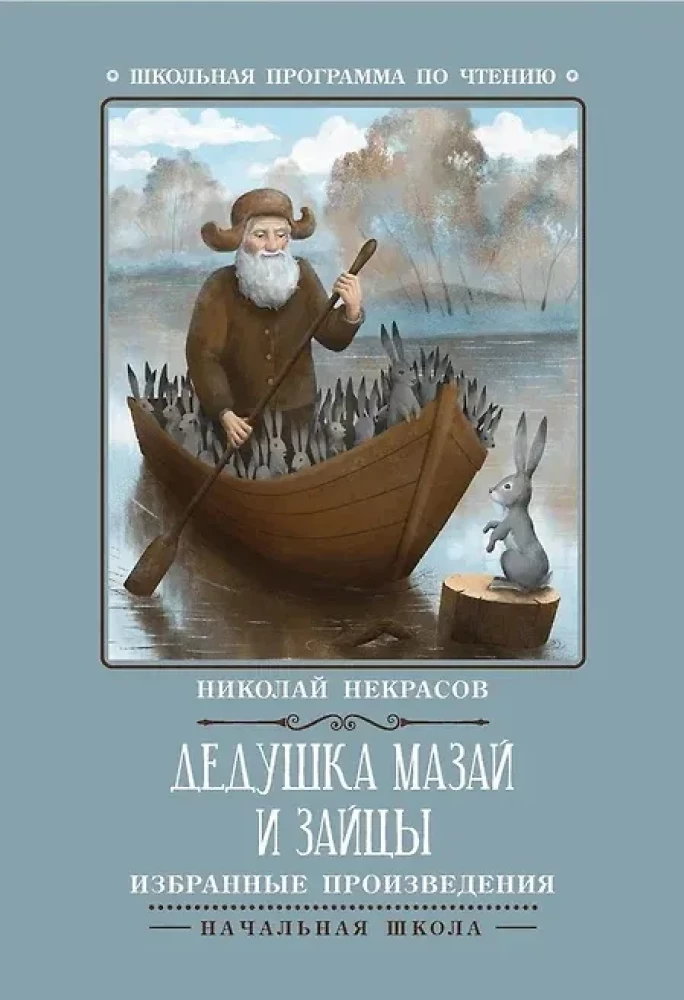
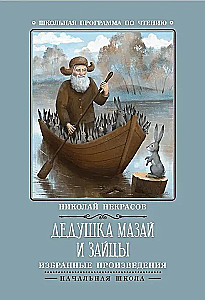
Grandfather Mazai and the Hares. Selected Works
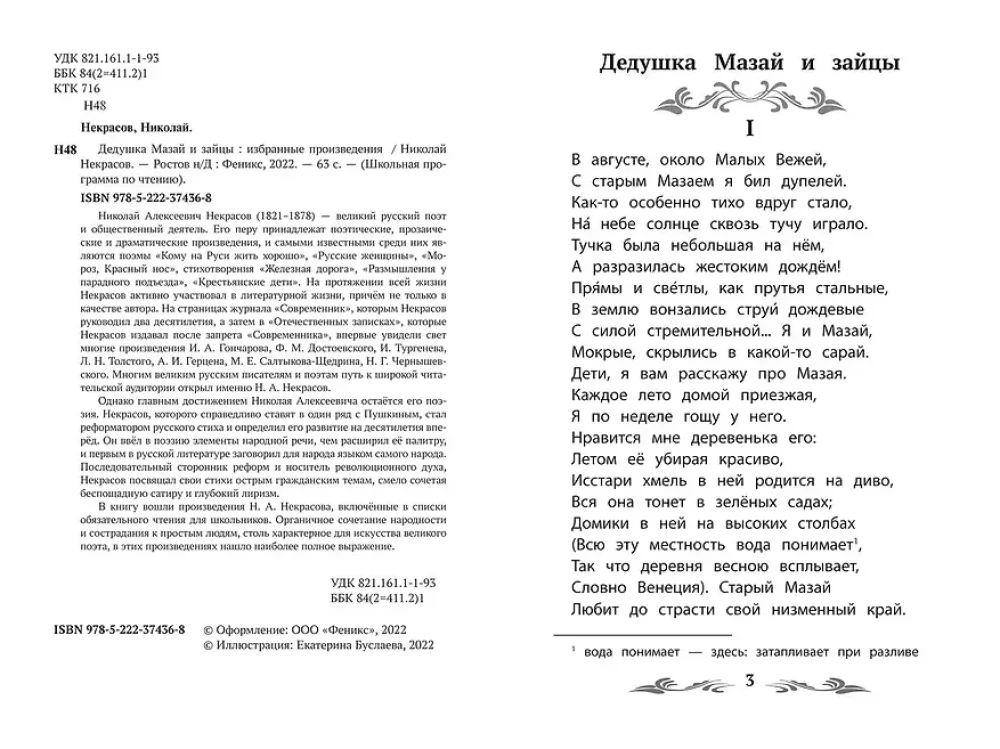
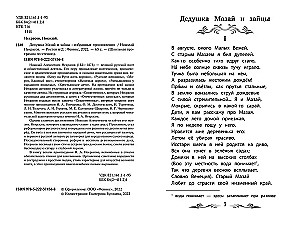
Nikolai Alekseevich Nekrasov (1821-1878) - a great Russian poet and public figure. His pen gave birth to poetic, prose, and dramatic works, among which the most famous are the poems "Who is Happy in Russia," "Russian Women," "Frost, Red Nose,"...
and the poems "The Railway," "Reflections at the Grand Entrance," "Peasant Children." Throughout his life, Nekrasov actively participated in literary life, not only as an author. Many works of I. A. Goncharov, F. M. Dostoevsky, I. Turgenev, L. N. Tolstoy, A. I. Herzen, M. E. Saltykov-Shchedrin, N. G. Chernyshevsky first saw the light on the pages of the magazine "Sovremennik," which Nekrasov directed for two decades, and later in "Otechestvennye Zapiski," which Nekrasov published after the ban on "Sovremennik." To many great Russian writers and poets, the path to a wide reading audience was opened by N. A. Nekrasov.
However, the main achievement of Nikolai Alekseevich remains his poetry. Nekrasov, who is rightly placed on par with Pushkin, became a reformer of Russian verse and determined its development for decades to come. He introduced elements of folk speech into poetry, thus expanding its palette, and was the first in Russian literature to speak to the people in the language of the people themselves. A consistent supporter of reforms and a bearer of revolutionary spirit, Nekrasov dedicated his poems to sharp civic themes, boldly combining ruthless satire and deep lyricism. The book includes works by N. A. Nekrasov included in the lists of mandatory reading for schoolchildren. The organic combination of folkness and compassion for ordinary people, so characteristic of the great poet's art, found its fullest expression in these works.
However, the main achievement of Nikolai Alekseevich remains his poetry. Nekrasov, who is rightly placed on par with Pushkin, became a reformer of Russian verse and determined its development for decades to come. He introduced elements of folk speech into poetry, thus expanding its palette, and was the first in Russian literature to speak to the people in the language of the people themselves. A consistent supporter of reforms and a bearer of revolutionary spirit, Nekrasov dedicated his poems to sharp civic themes, boldly combining ruthless satire and deep lyricism. The book includes works by N. A. Nekrasov included in the lists of mandatory reading for schoolchildren. The organic combination of folkness and compassion for ordinary people, so characteristic of the great poet's art, found its fullest expression in these works.
Author: Николай Некрасов
Printhouse: Feniks
Series: School Reading Program
Age restrictions: 0+
Year of publication: 2022
ISBN: 9785222414637
Number of pages: 63
Size: 210х140х3 mm
Cover type: soft
Weight: 70 g
ID: 1706358
Sold out
€ 2.59
Sold out
€ 2.59