
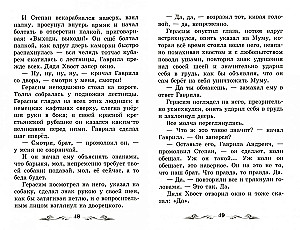
Mumu
Ivan Sergeyevich Turgenev (1818-1883) - a classic of Russian literature of the second half of the 19th century, author of numerous significant works ("Rudin", "A Nest of the Gentry", "On the Eve", "Fathers and Sons", "Asya", "First Love", "Spring Waters",...
"A Month in the Country").
The Turgenev family came from an ancient lineage of Tula nobility and was wealthy. The childhood of the future writer was spent in the estate of the village of Spasskoye-Lutovinovo in the Mtsensk district. Young Ivan was taught by governesses, and the French language, favored by his mother, was almost the main language in the house. This did not prevent him from falling in love with Russian literature; he began writing at the age of 15, and by 19 he had already composed about a hundred poems and verses. Turgenev received his education in private boarding schools for the nobility, and later at the Faculty of Philosophy of St. Petersburg University. In his work, the writer responded to all the events of his time: he was the first to embody the contradictory image of the "new person" - the nihilist, realistically described the life of the people, fought for the abolition of serfdom, assessed the changing role of women in society, and finally, was the first to depict humble rural landscapes with such sincere love and lyricism.
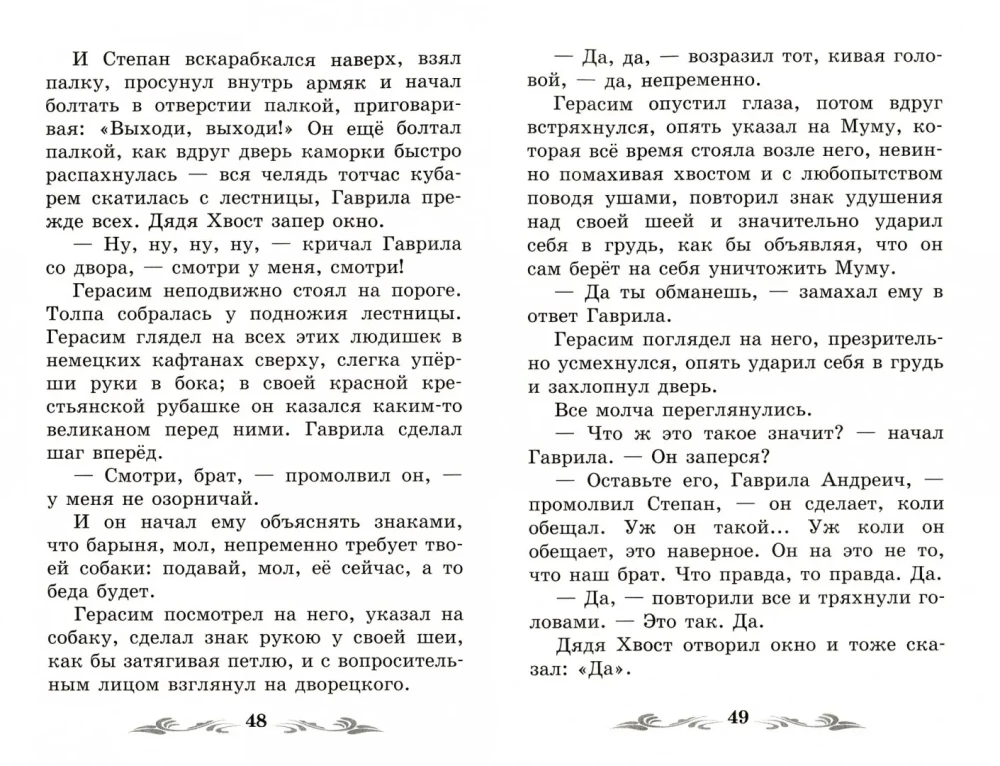
In 1852, being under arrest due to a published obituary on the death of Gogol, Turgenev wrote the now-classic story "Mumu". He contrasted the capricious, cruel noblewoman with a true hero, who, however, cannot speak and is not free in his feelings. The symbolism of the hero, the personification of the unfree peasant, was so obvious that censorship long forbade the story from being published. Interestingly, it is based on real events: the prototype of Gerasim was Andrei the Mute, a janitor at the Moscow house of the Turgenevs, who indeed drowned his dog Mumu, doing so by the order of the writer's mother.
The Turgenev family came from an ancient lineage of Tula nobility and was wealthy. The childhood of the future writer was spent in the estate of the village of Spasskoye-Lutovinovo in the Mtsensk district. Young Ivan was taught by governesses, and the French language, favored by his mother, was almost the main language in the house. This did not prevent him from falling in love with Russian literature; he began writing at the age of 15, and by 19 he had already composed about a hundred poems and verses. Turgenev received his education in private boarding schools for the nobility, and later at the Faculty of Philosophy of St. Petersburg University. In his work, the writer responded to all the events of his time: he was the first to embody the contradictory image of the "new person" - the nihilist, realistically described the life of the people, fought for the abolition of serfdom, assessed the changing role of women in society, and finally, was the first to depict humble rural landscapes with such sincere love and lyricism.
In 1852, being under arrest due to a published obituary on the death of Gogol, Turgenev wrote the now-classic story "Mumu". He contrasted the capricious, cruel noblewoman with a true hero, who, however, cannot speak and is not free in his feelings. The symbolism of the hero, the personification of the unfree peasant, was so obvious that censorship long forbade the story from being published. Interestingly, it is based on real events: the prototype of Gerasim was Andrei the Mute, a janitor at the Moscow house of the Turgenevs, who indeed drowned his dog Mumu, doing so by the order of the writer's mother.
Author: Иван Тургенев
Printhouse: Feniks
Series: School Reading Program
Age restrictions: 6+
Year of publication: 2026
ISBN: 9785222432693, 9785222465998
Number of pages: 124
Size: 208x140x8 mm
Cover type: soft
Weight: 134 g
ID: 1731453
Sold out
€ 4.39
Sold out
€ 4.39
Bestsellers






€ 9.89
In stock