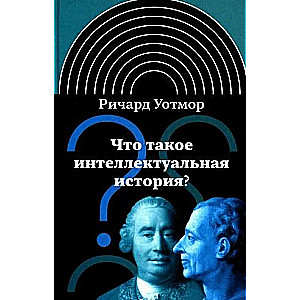
An engaging, meaning-rich, and concise book by Richard Whatmore, a leading representative of intellectual history in the English-speaking world, provides clear answers to complex questions. Why and how do scholars reconstruct the ideas and worldviews of people from past eras?...
How closely is this discipline related to the development of political thought? When does society have a need for such knowledge? The author traces the evolution of the approach from the early experiments of Hume and Montesquieu to the recent works of Skinner, Hont, or Darnton, discusses major discoveries of intellectual historians in the field of early modern political philosophy, and answers fundamental theoretical questions. Whatmore shows how philosophical, scientific, political, religious, and artistic ideas emerge and are shaped in various historical contexts, and then how they directly influence societal development and people's decisions. Introducing the reader to the current state of intellectual history, the scholar offers his own - accessible and convincing - definition of the boundaries of this discipline. Richard Whatmore is a professor of modern history and director of the Institute of Intellectual History at the University of St Andrews.
An engaging, meaning-rich, and concise book by Richard Whatmore, a leading representative of intellectual history in the English-speaking world, provides clear answers to complex questions. Why and how do scholars reconstruct the ideas and worldviews of people from past eras? How closely is this discipline related to the development of political thought? When does society have a need for such knowledge? The author traces the evolution of the approach from the early experiments of Hume and Montesquieu to the recent works of Skinner, Hont, or Darnton, discusses major discoveries of intellectual historians in the field of early modern political philosophy, and answers fundamental theoretical questions. Whatmore shows how philosophical, scientific, political, religious, and artistic ideas emerge and are shaped in various historical contexts, and then how they directly influence societal development and people's decisions. Introducing the reader to the current state of intellectual history, the scholar offers his own - accessible and convincing - definition of the boundaries of this discipline. Richard Whatmore is a professor of modern history and director of the Institute of Intellectual History at the University of St Andrews.
Be the first to know about our current discounts, offers and new products!
Check icon
You have added to your basket
Check icon
You have added to favourites
Sold out
The item is currently out of stock.
In stock
Available in warehouse. You will receive the exact delivery date from the operator after the order confirmation.
To order
The product is delivered directly from the publisher. The order processing time is up to 14 days, you will receive the exact delivery date from the operator after the order confirmation.